Newsroom

Texas Architect on The Drive-In

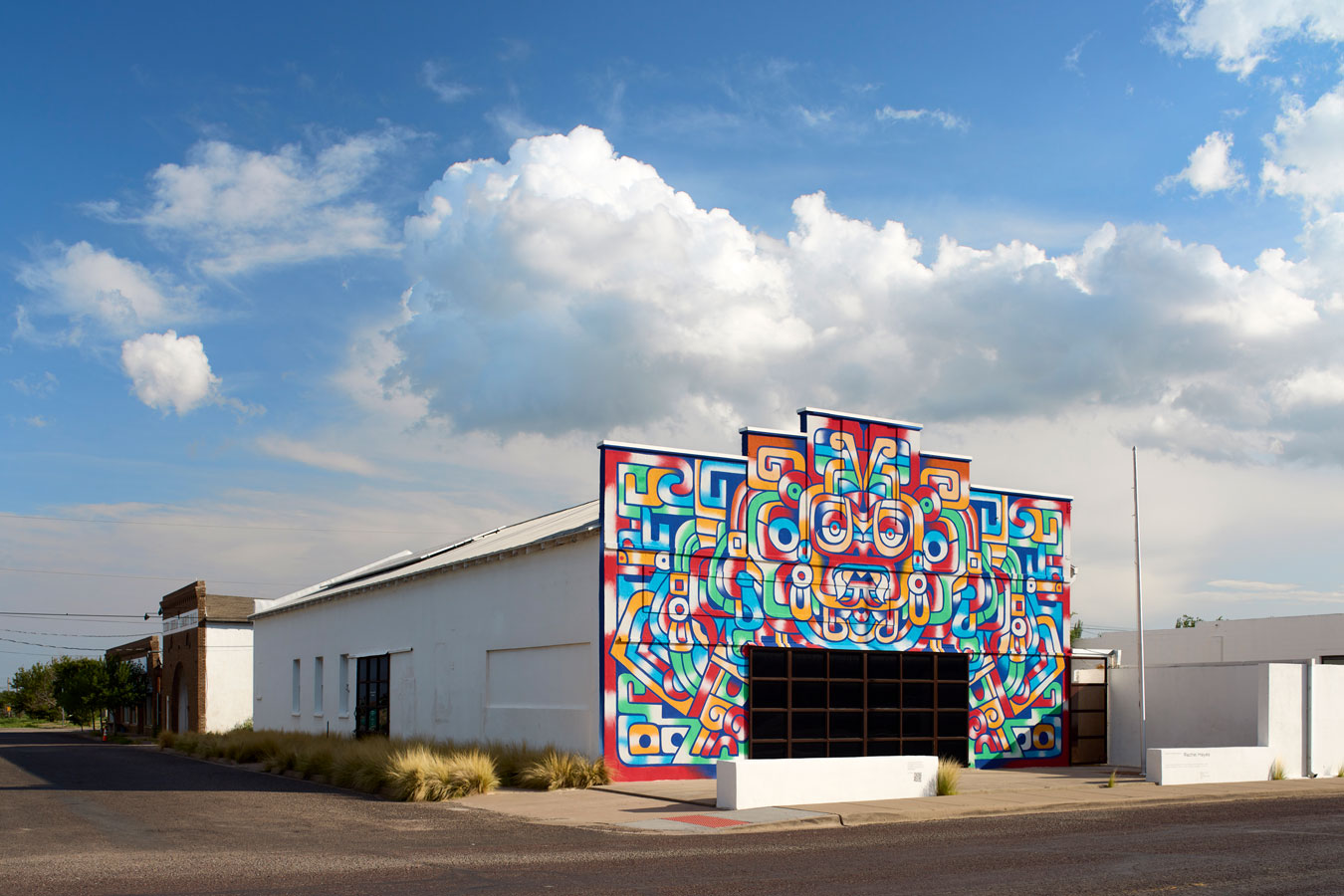
Texas Architect Drive-In

The official publication of the Texas Society of Architects weighs in on the Ballroom Marfa Drive-In:

“We hadn’t experienced weather as an object until we lived in Marfa,” said Michael Meredith, AIA, and Hilary Sample, AIA, founders of MOS. “The West Texas landscape naturally recedes into an infinite and scaleless distance, resisting a static sense of location or enclosure.” The design team thus sought a solution that would at once flow into the endless horizon and interrupt it.

Keep reading …

Comic Future Primer: Walead Beshty

September 19, 2013

https://ballroommarfa.wpengine.com/?attachment_id=11695

Unmasking (Action Comics 379, Adventure Comics 349, Alpha Flight 12B, Batman 321, Batman 458, Batman 506, Batman Family Giant 9, Betty and Veronica 117, Black Magic 1A, Black Magic 1B, Black Orchid 428, Black Orchid 429, Blackhawk 210B, Blood and Shadows, Bob Hope 93, Boris The Bear 11, Brave and the Bold 176, Captain America 311, Captain America 320B, Captain Planet 800, Daredevil 241A, Daredevil 358. Detective Comics 507, Detective Comics 407B, Excalibur, Gen13 53, Giant Teen Titans Annual, Green Lantern 69, Hawkeye 1, House of Mystery 237, Iron Man 103, Jimmy Olsen 59, Jimmy Olsen 79, Jimmy Olsen 111)
2012
41 Comic books
each: 14 1/4 x 18 inches
Courtesy of the artist and Regen Projects, Los Angeles

Before the opening of Comic Future on September 27th, we thought it might be helpful to provide some background reading and information about some of the artists and their work represented in the show. First up is this introduction to the work of Walead Beshty from Ballroom’s intern, Rebecca McGivney, who writes here about Beshty’s 2012 work, Unmasking.

————————————

Unmasking is composed of isolated panels from 41 comic books, each depicting a character removing his/her disguise either forcibly or voluntarily. Although a compelling piece on its own, it is made even more arresting when one consider how much it differs from the rest of Beshty’s oeuvre. Beshty, who is most-well known for his colorful photograms and glass boxes transported in FedEx containers, rarely uses found material, instead preferring to emphasize the human touch in his work. Although Unmasking appears to dramatically differ from Beshty’s previous pieces, thematically the work fits in with Beshty’s continued interest in the demystification of the artist’s process and the subject of transition.

In Unmasked, Beshty’s interests are made manifest through characters who are literally revealing what lies beneath the surface. Often caught in the midst of removing their disguises, these subjects are seen in transition; they are in between two completely separate identities and it is this in between space that interests Beshty fully. As he notes in his 2008 article “Abstracting Photography”:

The world we see from transitional spaces— the world outside the window; the world from the perspective of escalators, people movers, monorails, and shopping centres—has become an intellectual bogeyman, a storage container for all our
alienations. These infrastructural interstitial zones stand as compromised, indeterminate way stations between chimerical destinations. As an open field they occupy the space of bare fact, which we should approach with suspicion, but they are also unprocessed, and this has potential.

Beshty fixates on the liminal, on the moment of flux, because of its “potential” for transformation. It is this interest in transition that makes Beshty, and particularly Unmasking, such a great fit for Comic Future, an exhibit composed of works, which examine our (often) grim future through a cartoonish and/or ironic lens. Beshty’s pieces are always dynamic, either themselves in transition or depicting places or objects that are, but even more relevant to the exhibition, their final outcome is often unknown to the artist, his work being shaped by a symbiosis of chance and human (the artist’s) intervention, leaving their fates as uncertain as ours.

For more reading on Beshty and his process, particularly on his interests in the transitory, read Jonathan Nisbet’s excellent 2011 article for X-Tra. An excerpt:
Graham Reynolds’ Marfa Triptych: First Listen!

September 18, 2013

Preview the first installment in Graham Reynolds The Marfa Triptych with these preliminary sketches of Part One: The Country and Western Big Band Suite. Click here to see the first installment of Reynolds’ documentation of this extraordinary project.

Tickets for the world premiere on November 16th here in Marfa at the Crowley Theater are now available online. Click here to reserve your seat! Half-price tickets are available in the gallery for all residents of Brewster, Jeff Davis and Presidio counties.

“Localized Histories” at Artpace

https://ballroommarfa.wpengine.com/?attachment_id=11637

Isa Genzken, “Untitled,” 2004. Adhesive, tape, and prints on aluminum. Courtesy of the Linda Pace Foundation.

If you’re in San Antonio (or feel like making a pilgrimage) be sure to stop by Artpace San Antonio where Ballroom Executive Director Fairfax Dorn recently organized Localized Histories, an exhibition composed of various works from the Linda Pace Foundation, which are all either created using found objects or use the technique of assemblage.

The exhibition includes work by artists Leonardo Drew, Tony Feher, Isa Genzken, Trenton Doyle Hancock, Thomas Hirschhorn, Christian Marclay, and Linda Pace.

From Artpace:

Localized Histories addresses the various formal and conceptual issues of space, time, process, and material. The exhibition explores the relationships between the static, found objects and their temporal nature to create something which extends beyond painting and sculpture.

Localized Histories will be on view from September 12 to December 29 in the Hudson (Show)Room at Artpace.

Graham Reynolds’ Marfa Triptych: Research and Composition

20130816_185110
My research and composition center in Marfa.

The Marfa Triptych is three portraits of West Texas as envisioned by Austin-based composer Graham Reynolds. The first installment, The Country and Western Big Band Suite, is set to premiere at the Crowley Theater in Marfa, Texas on November 16 at 8pm. Tickets are available online in the Ballroom Marfa store.

Half-price tickets are available in the gallery and at the door for all residents of Brewster, Jeff Davis and Presidio counties.

The multimedia, genre-hopping trilogy of performances is inspired by Reynolds’ interest in the intermingled populations of the Texas-Mexico border regions, from ejido to ranch to the visual arts community.

The Marfa Triptych Part One: Country and Western Big Band Suite, is an instrumental suite for 13 players, described by Reynolds as “classic instrumental country meets Western soundtrack meets power jazz rhythm section.” This performance includes contributions from country music veteran Redd Volkaert, along with other members of Reynold’s far-reaching group of collaborators.

This project is inspired by Reynolds’ trips from his base in Austin, Texas to the high desert grasslands of Far West Texas that Ballroom Marfa calls home. His approach combines local musical traditions — from cowboy songs and Southern jazz to the norteño music of Northern Mexico — with a personal perspective that comes from years of scoring film, theater and modern dance performances.

As the project springs from the culture of Far West Texas, Reynolds is currently in the process of working with Ballroom Marfa to coordinate research trips throughout the region in order to experience its culture and history firsthand. Through his own connections and via sources recommended by Ballroom, Reynolds has been keeping an itinerary that includes visits with musicians, historians, storytellers, artists and local legends from Terlingua, Alpine, Presidio, Shafter, Fort Davis, Valentine, Marfa and other far-flung locales in the Big Bend region.

This is the first installment in Reynold’s documentation of his progress, with more to come.

Click here to take a listen to demo versions of two songs from the Country and Western Big Band suite.

20130817_110137

Research excursions to Pile of Rocks and Fort Davis in search of inspiration and subjects.

20130816_201501
The double rainbow seemed like a good sign for this project.

20130816_202735

My interview with Adam Bork led me to watch the sunset from a bench on the west edge of town.

Rashid Johnson’s “Remembering D.B. Cooper”

September 13, 2013

d_b_cooper_wanted_poster-r82ee087322bb4eacac74005fb677d480_wvw_8byvr_512

Ballroom alumnus Rashid Johnson — see our archive of photos from, New Growth his 2013 solo exhibition — has a new site-specific work on display in Chicago at moniquemeloche, entitled Remembering D.B. Cooper.

From moniquemeloche.com

Rashid Johnson’s Remembering D.B. Cooper transforms the 25 foot “on the wall” space into one of his iconic shelf works. The “on the wall” work will showcase a mix of Johnson’s signature materials– plants, black wax, books, albums, and shea butter — to explore the notion of escapism, an issue that continues to permeate his multi-dimensional practice. In Remembering D.B. Cooper, Johnson explores the personal as opposed to the political reasons for the famous, unknown highjacker of a Northwest flight in 1971- a media epithet known today as D.B. Cooper; today, the true identity of D.B. Cooper, who parachuted from the flight holding 200,000 worth of ransom money, remains unknown. Since his 2008 solo exhibition at moniquemeloche titled “The New Escapist Promised Land Garden and Recreation Center,” Johnson has carved out a space for a black secret society (the Boule) to study, meet, work, get their leisure on – and yes escape, and the lore of D.B. Cooper is yet another historical avenue for Johnson to mine.

Remembering D.B Cooper will be on display from now until January 4, 2014.

Who’s At Ballroom Marfa This Week?

phil and betty raughton

Gallery sitting can sometimes get a bit boring, especially when you are obligated to stay close to the desk rather than get pulled into the work exhibited. The bright spot, however, is the chance to speak with the various visitors who have decided to explore Marfa and Ballroom. This week I had the pleasure to speak with two of those visitors who stopped in for the final weekend of our Alix Pearlstein exhibition.

Phil and Betty Raughton had only just arrived in town from Abilene and even after the five hour drive were in good spirits and eager to see the town. The Raughtons helped pass the time by regaling me with stories of their artist son, Brian, who currently lives in New York City, working as a hotel concierge by day and DJ by night. We ended the lively conversation — Betty declined to be interviewed but was happy to talk off-mic — with a breakdown of the different dinner options in Marfa and I got to hear their thoughts on the town thus so far.

Ballroom Marfa: What brought you guys to Marfa?

Phil Raughton: The CBS story on Marfa and we wanted to come see for ourselves what it was like.

BM: And where are you both from?

PR: Abilene, Texas. 358 miles.

BM: Did you drive all the way here?

PR: All the way!

BM: Was it a nice drive though?

PR: Oh yeah… It’s only about 5 hours here, so…

BM: Only! And is Ballroom the first place you visited?

PR: Yes.

BM: What did you think of the gallery?

PR: I love it, absolutely love it. It’s very unusual and it was not what I expected. It was more than what we expected. It was very good, we enjoyed it.

BM: Did you like Alix Pearlstein’s work?

PR: Ah! I liked it, it was a little unnerving, I’d like to know how she did it, but it was very well done. I’ve never seen anything like it before.

BM: And of the other works in the gallery what was your favorite?

PR: I like the Prada sign. [points to James Evans’ Prada Marfa limited edition photograph]. I love it. I’ve seen the CBS broadcast two or three times and that’s still my favorite. I just love it because it’s so isolated.

BM: What are you looking forward to the most in Marfa?

PR: We’re going to go over and see the lights, if we can find them. The weather is fantastic and everybody that we’ve met here so far has been absolutely wonderful.